
6th September to 31st October 2025
One Island – Many Visions is a Portland Sculpture & Quarry Trust collaboration with the Royal Society of Sculptors, involving 27 artists’ residencies, and research outcomes over 18 months, resulting in the exhibition, symposium and community events.
Royal Society of Sculptors members have worked collaboratively with PSQT Living Land Archive Project for the regeneration of quarry landscapes alongside members of the Portland community.
Roger has been carving stone intermittently for about 65 years. He qualified as a stone mason gaining a City and Guilds Advanced Diploma with Distinction and worked at Salisbury Cathedral, before moving on as a sculptor.
He has prizes from Discerning Eye, The Atkinson Gallery, Onyx Environmental Trust and The Salisbury Civic Society, Lady Radnor Award.
His work is drawn from nature, industry, politics and literature, exhibiting in France, the RWA, Bristol, Messums Fine Art and Cadogan Contemporary, London, plus other exhibitions every year since 1996.
In the Drill Hall:
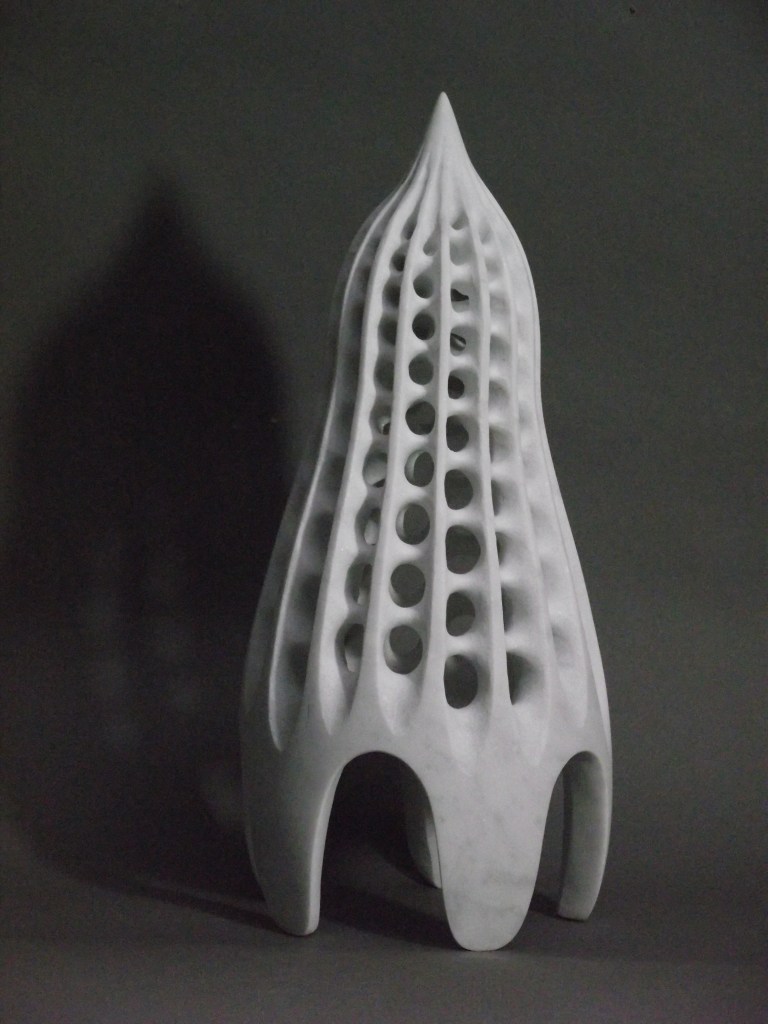
LAMPROCYCLAS MARITALIS.
Lamprocyclas Maritalis is a single cell marine organism, with intricate silica skeletons.
They are the main constituent of “Chert”, a stone masons’ nightmare, which occur as individual nodules or beds in limestone.
Chert consists of siliceous fossils which die, sink to the seabed and precipitate in between shell fragments, to become hard bedded rock nodules.
In rare cases, a Medieval stone mason would leave the chert nodule protruding from the surface of the worked stone. This was long before diamond saws and tungsten chisels.
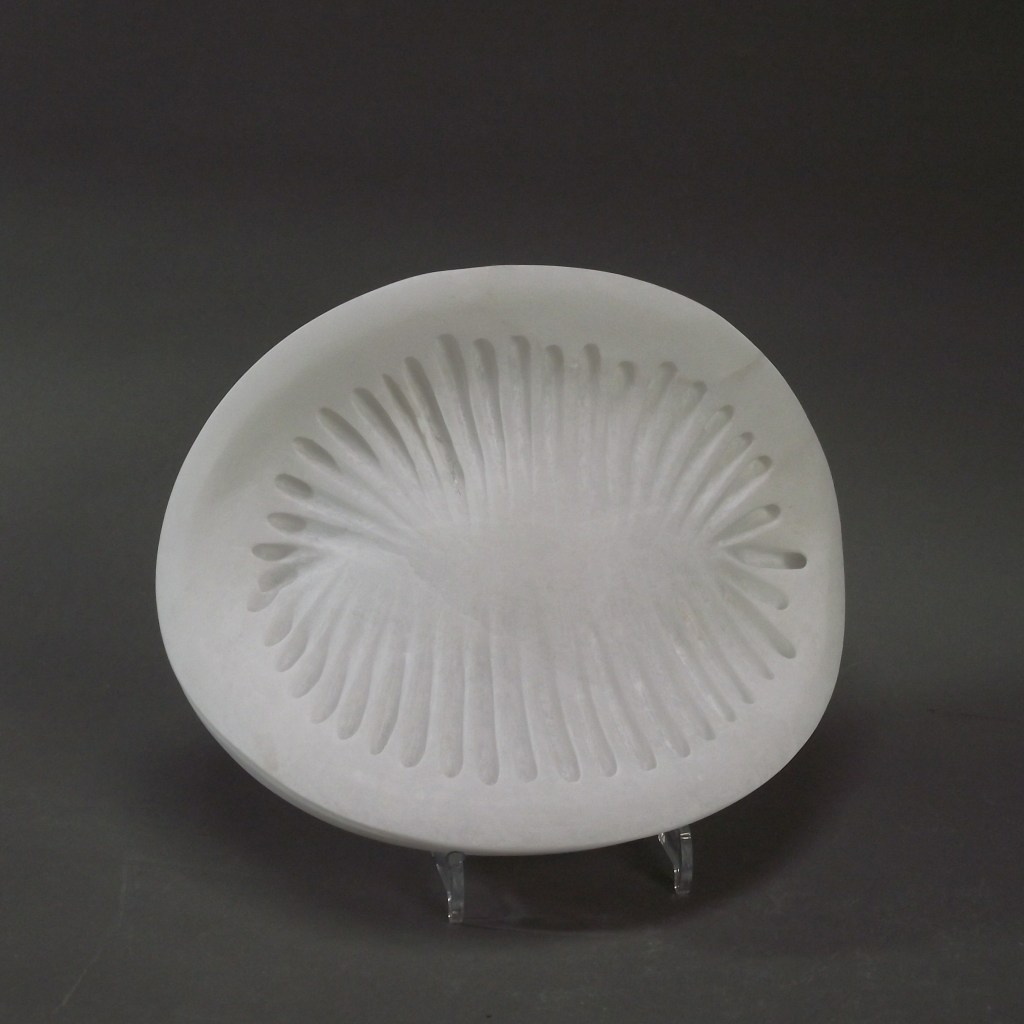
CAMPYLODISCUS HIBERNICUS
Campylodiscus Hibernicus is a Diatom, a single cell algae with a silica casing occurring worldwide in salt and fresh water and anywhere that is damp. So numerous are they, they contribute 20-50% of the world’s oxygen and carbon capture which they then photosynthesize the carbon dioxide into oxygen.
Diatoms are sensitive to environmental conditions and are good bioindicators.
The dead Diatoms precipitate and can be found in Chert.
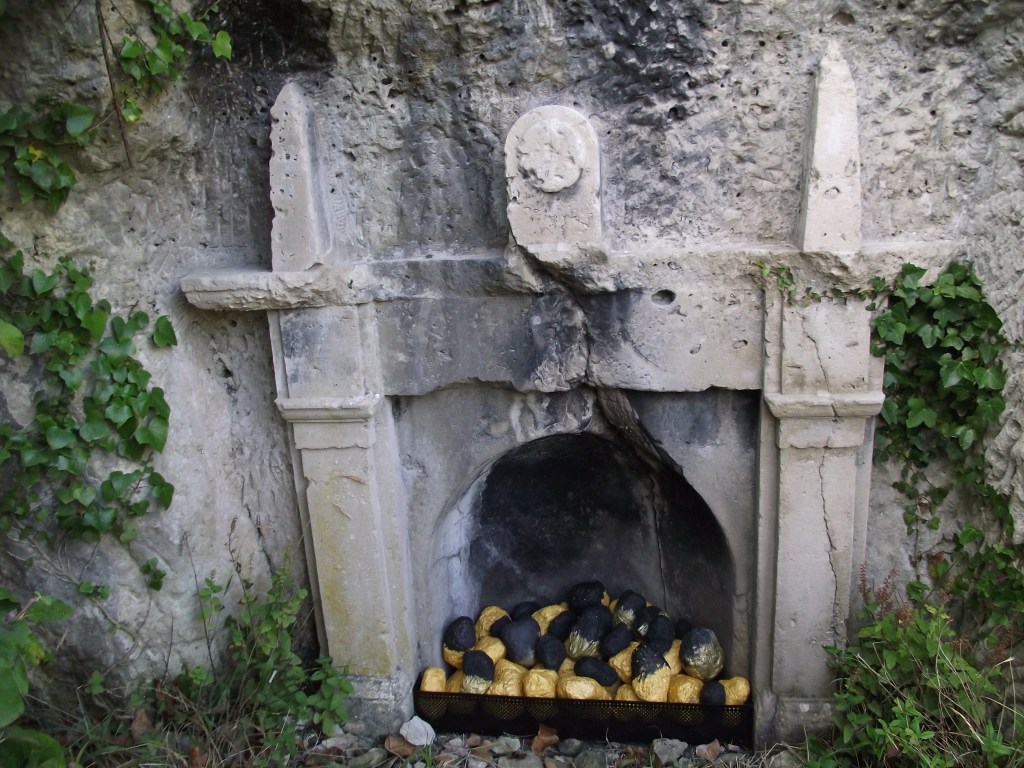
In the quarry: Position: “Hearth”
“ALL THAT GLITTERS IS NOT GOLD”
With the kind permission of Timothy Shutter, sculptor of “Hearth”.
Coal was the driver of the Industrial Revolution, enabling Britain to be the world’s leader in commerce. But it led to pollution here and in Europe and eventually the world.
The gold “coals” are emblematic of the significance of generated wealth, but the gold gradually turns to black revealing its true colour that reflects the damage that has been done to the environment.
 Roger Stephens